Your team’s fate is in your hands. Choose badly and you’ll come to a sticky end. Choose wisely and you stand the chance of living happily ever after. What will you choose to do?
They say time flies when you’re having fun so if you’ve ever dreamed of writing a book, I highly recommend giving it a go. With plenty of caution, of course – because this is the only responsible and fair thing to do when it comes to doing work from the heart.
In my case, the result is the first ever Agile business novel in the format of gamebook – a fun and interactive story with eight different endings where you, the Reader, gets to put your Agile knowledge and experience to the test.
Back in the autumn 2011, The Dream Team Nightmare began as a personal challenge to see if I could write a book at a time in my life when I wanted to gift back something of me to the world.
Now, as I complete writing my second book and delight in the gifts of feedback from my first readers, I feel incredibly fortunate to have followed the wisdom of my heart. After all, this is the Play Way.
If you’re part of a book club that enjoys having fun as you read, I’d love to pay you a visit (be it online or may be even in-person) to explore and experience the exquisite adventure that is reading – in community!
The Secret to Heartwork
It’s possible that when it comes to writing a book, you find it easy. Believe or not, I’ve met writers for whom this is true. Or you might find it as tough as climbing Mount Everest which is my case (although I’ve yet to climb Mount Everest for real but I’ve been working on my yoga crow pose – slowly, slowly, catchy monkey – in preparation for a handstand or forearm stand). And that’s the thing. Whenever we do anything truly, madly, deeply important to us, it requires hard work because it’s heartwork.
The truth is, I’ve spent most of my life working from my heart. It may sound simple, but up until recently, it’s been anything but easy. Fortunately, I discovered in my wonder years the profound joy that comes from embracing a challenge and doing something for the sake of doing it and because my heart wants to (regardless of what those around me have to say on the matter).
The trick I’ve found about writing a book is to treat it as an adventure of self-discovery par excellence. If what I have come to know as play alchemy has taught me one thing, it’s that “The greater the purpose, the more fun you need to have”. In spite of the ginormous challenge writing a book may seem to you, just imagine how much more fun and joy you’ll experience if having fun and joy becomes part of the process.
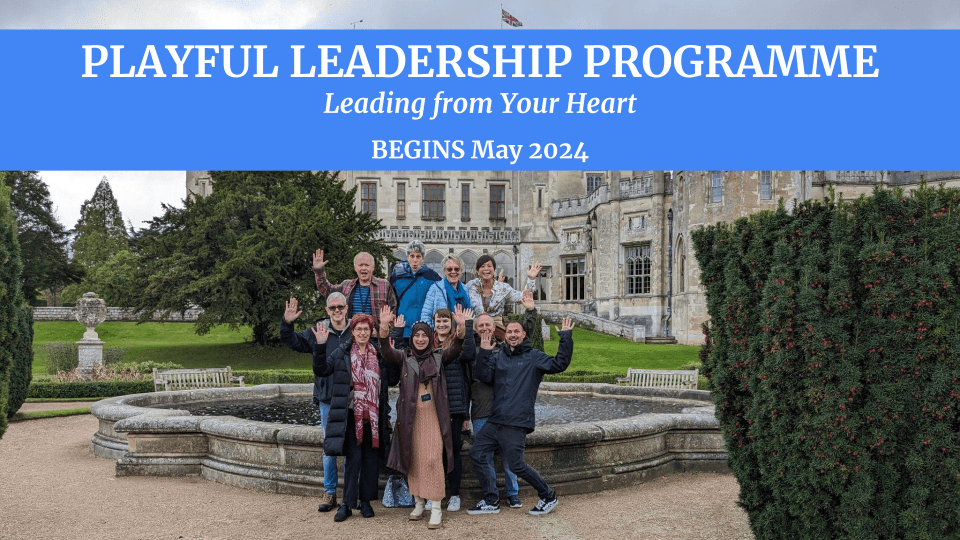
If you’re looking to learn how to lead from your heart and have fun doing it, then you’ve come to right play space!
Playful Leadership is a unique, intuitive and deeply resourcing approach to cultivating your own leadership based on the powerful quintuplet of Play Science, neuroscience, psychology, coaching and Systemic Constellations. It is grounded in what Portia Tung, the founder of The School of Play, calls Play Alchemy which is made up of the process, tools and techniques for transmuting the seemingly insurmountable challenges we face into positive outcomes so that we can thrive, have fun and get more of what we want done in a VUCA world.
When asked how best to describe their experience on the Playful Leadership programme, participants unanimously agree with a smile and a cheer, “It’s not a course, it’s a PLAY-cation!” That’s because the word PLAY-cation sums up neatly that wondrous tingling feeling we get after a proper holiday from the routine and mundane and of having achieved a profound transformation that took barely any effort because it was so much fun.
Over the past 20 years I have played with change in a range of financial institutions with variable success. Then a year ago, I was invited to join a bank-wide transformation like nothing I had ever experienced before. If I had only three words to describe my first impressions a month after my arrival about the bank’s culture, they would be: Friendly, capable and open.
A year on and those words still hold true. What’s more, for many of us these may also be the same three words we wished we could use to describe not just the institutions we entrust our life savings to, but also the places where we do our life’s work.
For the past year I have provided individual and group coaching to senior managers and their teams, as well as individual leadership coaching to organisational change agents such as Scrum Master and Agile Coaches. I have co-designed and co-delivered Agile and leadership training, facilitated numerous programme increment planning for groups in person and remotely as well as accompanied a number of programme teams on their Agile journey.
A Different Kind of Agile Adventure
“So what?” I hear you say. What has made my latest Agile Adventure different to those in the past, is this. By taking a more systemic stance, seeing, thinking and taking action with the whole system in mind, I have enabled more positive and enduring change… Sooner with less effort. Repeatably. Continuously. And have more fun. As many of my colleagues will agree.
So what’s my key learning? In order to do my life’s work, I need to continuously transform myself. Sounds simple and is anything but easy.
My Three Lifesavers
As a wise Agile coach once said to me, “A dead Agile coach is no good to anyone.” Here are my three latest lifesaving principles as I learn to sail my ship:
Keep my own drama out of my work
Do I what I do best
Remember what my work is in service of – not only the individual but the system as a whole.
Symbiosis of Change and Change Agent
Thank you to everyone with whom I’ve had a chance to work with and learn from in the past 12 months. It’s been jampacked with challenge and delight. A year on from an auspicious beginning, as this particular chapter now comes to an end, I am physically and mentally fitter and healthier than when I started. And if my body could still grow vertically, I’d be at least an inch taller now 12 months later.
Here’s one way I’ve found to enable transformational change and have lots of fun doing it. With love. Au revoir! Auf Wiedersehen! Play on!
“Be the change you wish to see in the world.” – Mahatma Gandhi
Today I invite you to explore a topic from one of the many systems to which I belong, the world of Agile. And the topic is Agile Leadership, a concept made of two halves.
On the one hand, there’s “Agile” the family of methods for delivering value that is iterative and incremental. I began practicing Agile shortly after its inception when I began my professional life as a Java developer 19 years ago. The key to learning about Agile for me is this: To be agile, you have to practice Agile. Sounds simple and is anything but easy. Otherwise, Agile wouldn’t continue to be as much of an industry as it is today.
On the other hand is “Leadership” which requires an understanding of how systems work, in particular, relationship systems. What do I mean by “relationship system”? I find this avian metaphor from Coaching Constellations creator John Whittington useful.
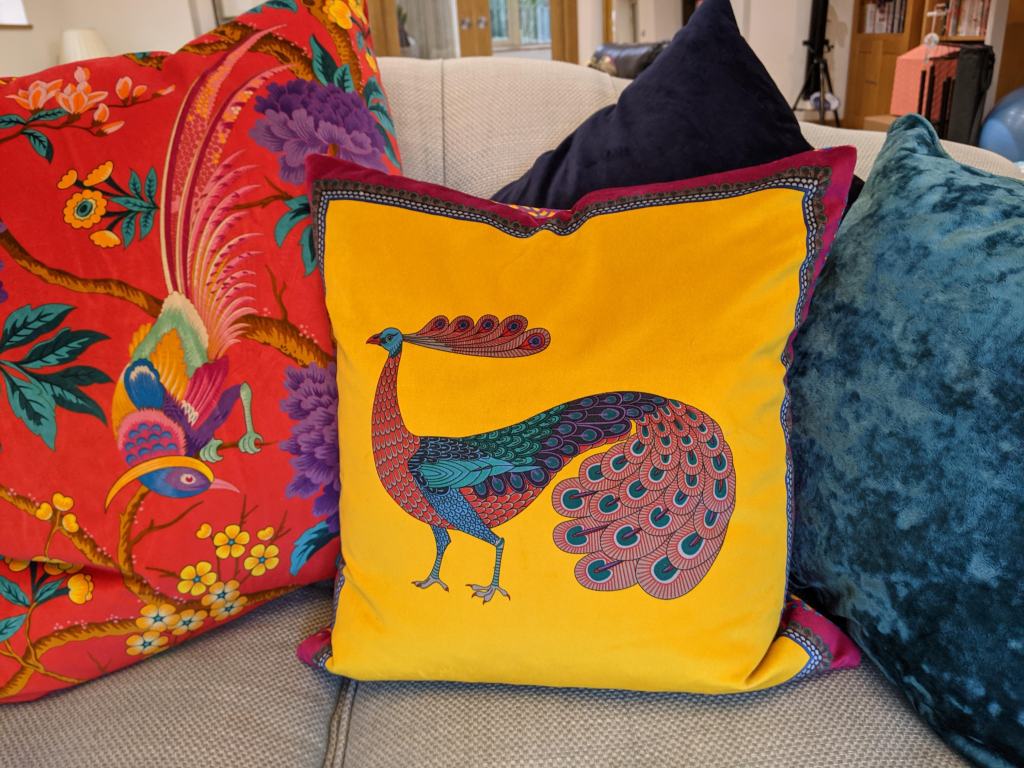
Peacock Present
Imagine each of us are a peacock. Behind each of us is a fan of feathers, with each feather representing a relationship system we have come from. From education systems, to previous professional systems as well as current professional systems, to social and cultural systems. And, of course, our family of origin. It’s no wonder that when we get together as groups and teams in an organisation, we end up ruffling each other’s feathers. Peafowl and politics indeed.
And just before you lose hope at the seemingly impossible mission of changing a system for greater good in your lifetime, it turns out you are key to that change. Why? Because as a systemic leader, the first system to look at is your own. In principle, we each stand a better chance of changing ourselves than those around us. As a systemic leader, you work on your own “system” in service of the wider system, your organisation.
Let’s Go Play in the Field
Where are you right now in relation to Agile Leadership? Notice what comes to mind. Or perhaps in your body. Simply acknowledge what is. That is enough.
The Route to Healthy Organisations
During my play research, I stumbled upon a curious discovery. The word “business” according to the ancient Chinese translates to mean literally “meaning of life”. If this is true, organisations can be a place where you can do your life’s work. Living your life’s purpose. At work. Imagine that. And in order to live your life’s purpose, many of the great philosophers agree that we each need to work in service of the wider system and not the individual. To work for greater good. That’s what distinguishes a job from a career, a career from a calling.
The Five Ancient Agile Values
As a young IT professional trying to make sense of how organisations worked, one of the key texts that has shaped my professional path these past 19 years from developer to development manager to consultant then Agile coach and most recently executive and personal coach is Kent Beck’s Extreme Programming (aka XP) Explained (1st and 2nd editions). What captured my twenty-something heart and gave me the courage to work and play in service of something greater than myself are the XP values: Communication, Simplicity, Feedback, Courage and Respect. It seemed like fair play to me.
Agile Leadership Through a Systemic Lens
Communication: As leaders, it is essential that our “three brains” are aligned, the one in our head, our heart and our gut. Without this internal alignment, our leadership is as discombobulated as we are. This somatic coherence sounds simple and is anything but easy. Otherwise, leadership wouldn’t continue to be as much of an industry as it is today.
Being human is also about human-being and human-doing. It is a combination of thought and action. This is why it is important to know your values, to embody that knowing of what you stand for in all three brains so that you can live and breathe your values, day in, day out. This is what engenders trust. In yourself. And in others.
Simplicity: What do you do to add value? Is what you’re doing useful? Add value every day. Start small. As Chinese philosopher Laozi said, “A journey of a thousand miles begins with a single step.” Or in XP, one baby step at a time. The important thing is to begin. To live a value-driven and values-driven life.
Feedback: Take a look at yourself in the mirror. Notice any inner chatter. Acknowledge what is instead of wishing for what could be. A key systemic principle is the balance of exchange. A balance of giving and taking. Which of your three brains have you excluded? A systemic leader ensures each brain has a place just like each person in their team has a place. Anyone that is excluded will lead to organisational entanglements and difficulties that compromise organisational health for all.
Courage: Show up as yourself. From a centred place. A place of mindfulness and meditation. A place where you will not be easily recruited by other people and their stories which serve to only entangle the system further to the detriment of everyone in the system. Perhaps one of the most courageous acts for many is this: Play at work. Give it a go. I find inspires me and others towards a greater purpose. Leading by example.
Respect: This value was added in the second version of Kent’s book. And it was the game-changer for me. It addresses 3 key needs we all have as human beings: Belonging, safety and recognition.
Belonging: It ensures everyone has a place. No one is excluded.
Safety: Each of us agree to be the same-size. No one is bigger, no one is more than another.
Recognition: To truly see and be with one another requires us to “go beyond the field of right and wrong” and meet each other in the field of non-judgment described by Sufi poet Rumi.
A useful reminder regarding respect I’ve found among leaders is this: “Giving up wanting to help or to rescue people is essential if you sincerely respect them.” from the creator of Family Constellations Bert Hellinger.
Back in the Playing Field
Now that we’ve come full circle, I invite you to consider this: What would be a baby step towards better for you and each of those people or entities who are part of your Agile Leadership system? And if what you are contemplating were a chapter in a book, what would be the chapter heading in just a few words? Say them out loud. Play with the words until they feel true. To you.
Thank you for joining me in the field today. I had fun. I hope you had fun, too. I invite you to take what’s useful and leave behind what’s not with me. Let’s play again soon!
The Dream Team Nightmare by Portia Tung – A “Choose-Your-Own-Adventure” Agile novel with eight different endings designed to enrich and put your Agile knowledge and experience to the test. Contains useful exercises to try with your team as well as an Agile glossary. Also available on Amazon, Waterstones and Foyles online stores.
Flow of Life and Love in Systems
Flow by Mihalyi Csikszentmihalyi – Science-backed research on how to lead a meaning and productive life as described by ancient philosophers.



 THE SCHOOL OF PLAY